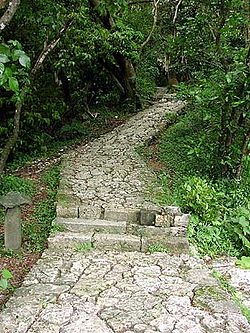

The Tamaudun is a mausoleum located in Shuri, Okinawa, built in 1501 for members of the royal family of the kingdom of Ryūkyū1 by Shō Shin,
third king of the second Shō dynasty, a short distance from Shuri castle.
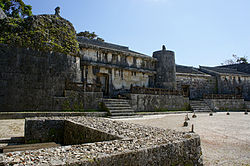
Sonohyan-utaki is a sacred grove of trees and plants (utaki) of the traditional indigenous ryūkyū religion.
It is located within the grounds of Shuri Castle in Naha, a short walk from the castle's Shureimon Gate.
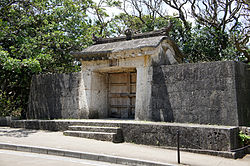
Nakijin Castle is a gusuku (castle or fortress of the Ryūkyū Islands) located in Nakijin, Okinawa Prefecture in Japan, now in ruins.
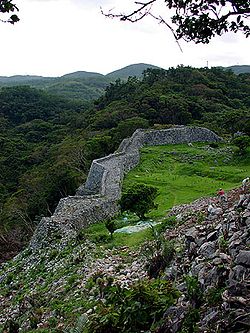
Zakimi Castle is a gusuku (fortress) located in Yomitan in Okinawa Prefecture, Japan.
It is now in ruins but the walls and foundations have been restored.
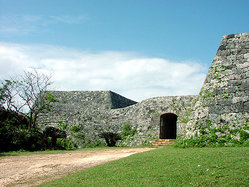
Katsuren Castle is a gusuku on the island of Okinawa in Japan. With the Pacific Ocean on both sides, it is also called « Gusuku Ocean ».
Its golden age is in the middle of the 15th century during the time of the powerful Lord Amawari.
Precious Chinese tiles and ceramics from the period have been unearthed in Katsuren.
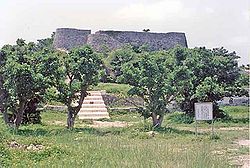
Nakagusuku Castle is a gusuku (fortress) located in the villages of Nakagusuku and Kitanakagusuku, on the island of Okinawa in Japan.
It is now in ruins. It is the second largest castle in Okinawa after Shuri. It is also one of the oldest castles in the Ryūkyū Islands.
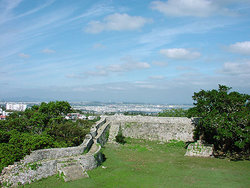
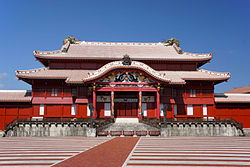
Shuri Castle, Okinawaiian: Sui ugusiku, is a gusuku, a form of medieval Japanese castle located in the city of Naha (formerly called Shuri),
the capital and main city of Okinawa Prefecture, Japan.
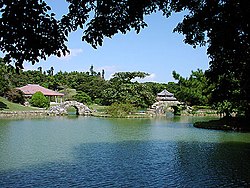
The Shikina-en is a residential garden on the Japanese island of Okinawa.
The total area of the garden is 41,997 m². In 2000, Shikina-en was inscribed with other monuments in Okinawa Prefecture.
Seifa-utaki, seifa refers to a high position and utaki, a sacred place is a Shinto shrine located in the Nanjō district.